CUSTOM PLATFORM BUILD

    Creative Display Works: One AI-Native Platform Replaces a 7-Tool Operations Stack

    Creative Display Works, a commercial display manufacturer, was running operations across seven disconnected SaaS tools spanning order planning, engineering, installation tracking, and reporting. Aries Consulting Group replaced the entire stack with a custom AI-native platform built on a single unified data layer — three connected apps (Office OS, Field Check-In, Inventory), Gemini-powered route optimization, and warehouse-floor TV dashboards. The platform is live across all departments and expanded monthly as the business evolves.

    7→1

    Tools consolidated

    Into one unified platform

    3 apps

    Office · Field · Inventory

    One shared data layer

    5 TVs

    Warehouse-floor dashboards

    Real-time shop-floor visibility

    Built on

    • Lovable
    • React
    • Supabase
    • Gemini 2.5
    • Mapbox
    • OpenWeather
    • Resend
    • PWA
    • Stripe
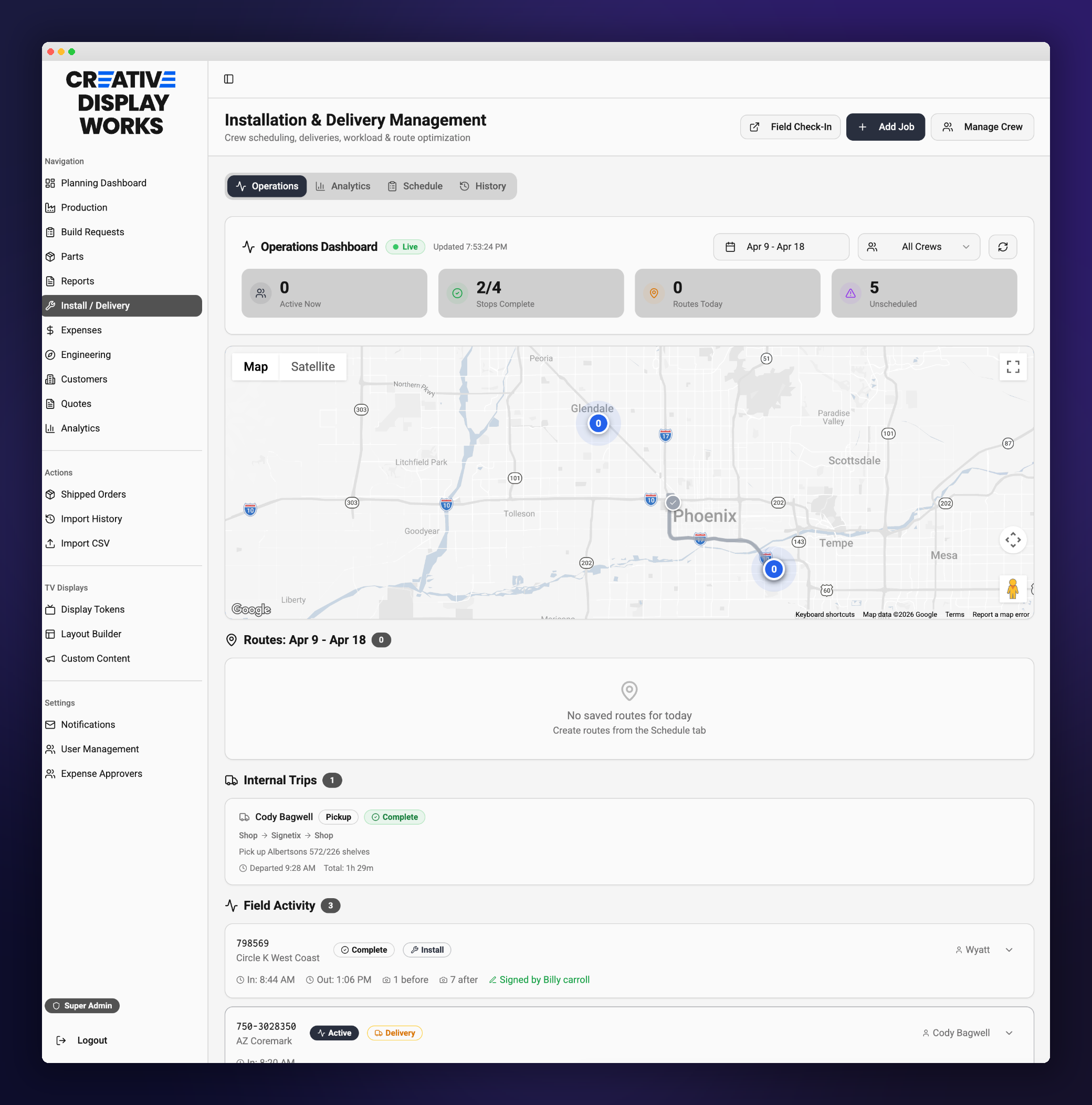
    Creative Display Works AriesOS — live install operations dashboard with route map, crew KPIs, and field activity log
    Office OS — live install operations dashboard with Gemini-optimized routes

    At a glance

    Client
    Creative Display Works Inc.
    Industry
    Commercial display manufacturing
    Company size
    Mid-market manufacturer
    Engagement
    Custom Platform Build + ongoing Growth Retainer
    Timeline
    Discovery 2–3 weeks, Build 4–8 weeks
    Outcome
    Live unified platform across all departments, maintained monthly

    The Challenge

    Creative Display Works had outgrown its tooling. Operations spanned seven separate SaaS systems — order planning in one tool, engineering specs in another, installation tracking in a third, fleet/route data in a fourth, inventory in a fifth, project management in a sixth, reporting pieced together from CSV exports. Data lived in silos. Every cross-functional decision required manual reconciliation across tools. The cost wasn't just the subscription fees; it was the lag between operational reality and leadership visibility.

    The founder, Tim Miloserny, had already priced out traditional consulting firms and custom dev shops. The quotes came back at six figures and 6–12 month timelines — neither of which fit the pace of the business.

    The Solution

    Aries Consulting Group deployed the full Custom Platform Build engagement, replacing the entire stack with a single AI-native operating system spanning three connected apps:

    • Office OS — the back-office workspace covering Quotes, Build Requests, Production Planning, Engineering, Install/Installation History, Parts, Inventory, Customers, Expenses, Reports, and Analytics. One sidebar, one login, one data layer.
    • Field Check-In — a mobile-first, PWA-installable app for install crews. PIN-protected sign-in, live job lookup, on-site sign-offs, and push notifications when routes change.
    • Inventory — a mobile-first PWA for warehouse staff. Branded QR labels generated in bulk; each QR deep-links to an update form so any team member with a phone can move inventory in seconds.
    • 5 warehouse-floor TV dashboards — TVDashboard, TVShipping, TVStations, TVPerformance, and a custom layout view. Real-time shop-floor visibility for the production team without anyone touching a keyboard.

    AI embedded from day one. Two production AI workflows (powered by Gemini 2.5 Flash via Lovable AI):

    • Daily route optimization — every install crew's day is sequenced by an AI agent that weighs stop locations, weather, install duration estimates, and crew assignments. No more whiteboard scheduling.
    • Dynamic re-routing — when a stop is added, cancelled, or runs long, the route is re-optimized in real time and pushed to the field crew's Check-In app. Dispatchers stop reacting; the system reacts for them.

    Beyond AI, the platform integrates address geocoding/validation, route matrix lookups, weather data, ERP order import (with rollback), an automated daily ops digest, and push notification infrastructure across 26 backend functions.

    Ongoing Growth Retainer. New modules added monthly as the business evolves. Platform is owned by Creative Display Works — code, data, and roadmap.

    The Results

    • Replaced seven disconnected tools with one unified platform across three connected apps
    • Real-time operational visibility across all departments — Office, Field, Inventory, and the warehouse floor (via 5 always-on TV dashboards) — previously required manual exports and reconciliation
    • AI-powered daily route optimization and dynamic re-routing eliminate manual dispatch work and surface the highest-value stop sequence automatically
    • Field crews work from a mobile PWA with push notifications — no SaaS seats, no per-installer license fees, no third-party app vendor
    • Platform live and actively maintained — new modules deployed on the client's roadmap, not a vendor's
    • Brand rebuild, modern B2B website, and strategic plan for a new sales team delivered in parallel with the platform build
    • Delivered faster and at lower cost than traditional consulting or dev-shop alternatives the founder had quoted
    What got built

    Real screens from the live platform

    Install operations dashboard showing live route map, crew KPIs, scheduled stops, and field activity log
    Install Operations — live route map, crew KPIs (Active Now, Stops Complete, Routes Today), and a streaming field activity log with crew sign-offs.
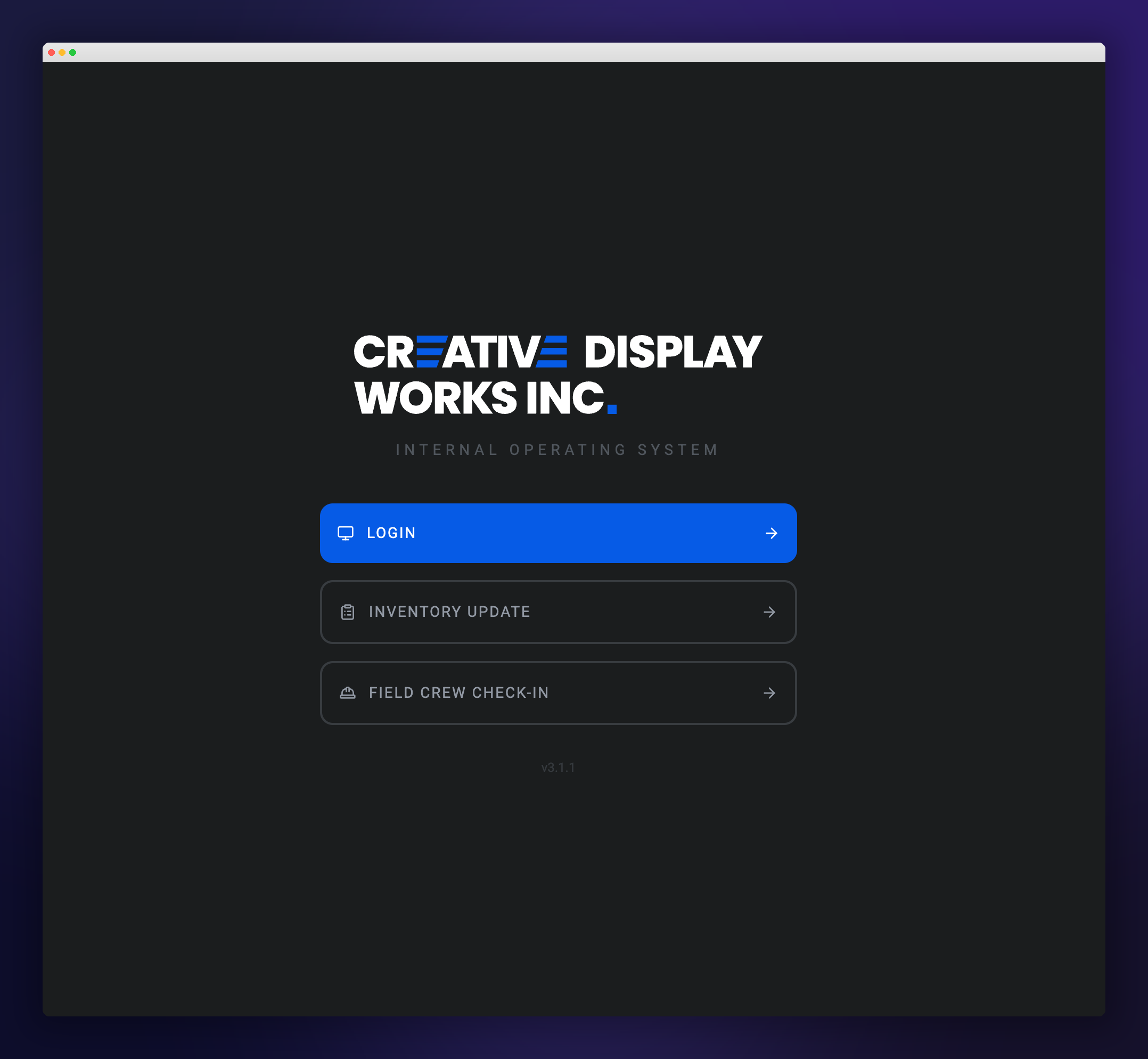
    Creative Display Works internal operating system landing screen with role-based entry points
    Internal OS landing — three role-based entry points (Office Login, Inventory Update, Field Crew Check-In) all backed by the same unified data layer.
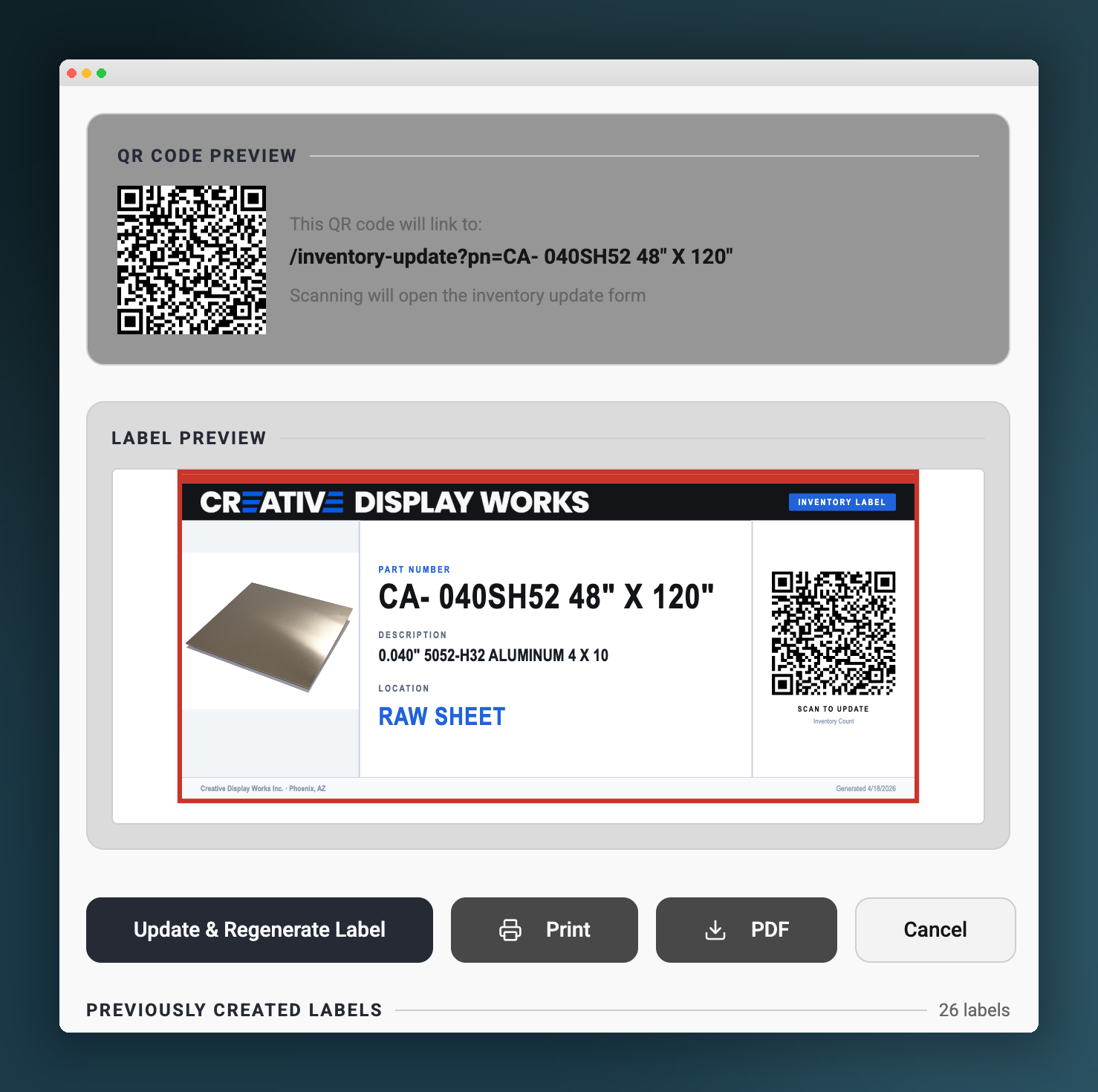
    QR inventory label generator producing branded labels with embedded QR codes deep-linking to mobile inventory update forms
    QR Inventory — generate branded labels in bulk; each QR deep-links warehouse staff to a mobile-first update form. No third-party inventory app required.

    "Adam embedded himself in our operation and transformed how we run our business. In just a few months, he formalized our organizational structure, rebuilt our brand from scratch, designed a soon-to-be-launched modern B2B website with AI-powered tools, implemented and optimized our CRM, developed custom-tailored production software, and built the entire strategic plan for our new sales team. The clarity and systems he put in place positioned us to scale with confidence. What would have cost us hundreds of thousands through traditional firms, Adam delivered faster and better."

    Tim MilosernyPresident & CEO, Creative Display Works Inc.

    Why It Worked

    Three decisions made the difference:

    1. Diagnose before building. The Discovery phase surfaced which workflows actually needed custom tooling vs. which could stay on existing systems. Nothing got built that didn't need to be built — and the three-app split (Office / Field / Inventory) emerged from how the business actually operates, not from a template.
    2. Single data layer from day one. Every module — and every app, including the five warehouse TV dashboards — reads from and writes to the same unified data store. That's what makes the AI route optimizer useful: it can see jobs, crews, parts, and customer locations in one query, instead of being trapped behind individual tool APIs.
    3. Embedded partner, not a delivered project. A dev shop would have shipped the platform and disappeared. Aries stays embedded as a Growth Retainer partner — new modules get built as the business discovers new needs, frontier models get swapped in as they ship, and the platform compounds.

    Could This Work for Your Business?

    Creative Display Works fits the Aries ICP: a founder-led company doing $2M–$50M in revenue, running 5–10 disconnected SaaS tools, with real operations across multiple departments. If you're at that stage and spending more time managing tools than running the business, the first step is the AI Readiness Audit — a 2–3 week scored diagnostic that tells you exactly what to build, automate, or buy.

    Common questions

    Questions buyers ask about this engagement

    How long did the AriesOS field-services build take?

    Discovery ran 2–3 weeks, and the initial Platform Build landed in the 4–8 week range — meaning Creative Display Works had a working unified platform replacing seven SaaS tools inside roughly 2–3 months from kickoff. New modules ship monthly under the Growth Retainer (the platform expands as the business evolves), but the core Office OS, Field Check-In, Inventory, and the five warehouse-floor TV dashboards were live across all departments well inside the 6–12 month timelines the founder had been quoted by traditional dev shops and consulting firms.

    Was off-the-shelf field-service software like ServiceTitan or Housecall Pro considered first?

    Yes. Off-the-shelf field-service platforms (ServiceTitan, Housecall Pro, and similar SMB-focused tools) were evaluated during Discovery and ruled out for a clear reason: they're built for service-trade businesses (HVAC, plumbing, residential field work), not for a commercial display manufacturer with custom production planning, engineering specs, install routing, and warehouse-floor TV dashboards on the same data layer. Adopting one would have solved 30% of the problem and required three or four additional tools (and the integration tax that comes with them) to cover the rest. AriesOS replaced the entire stack — Office OS, Field Check-In, Inventory, and the TV dashboards — on a single unified data layer instead.

    What did the team use to run operations before AriesOS?

    Seven disconnected SaaS tools spanning order planning, engineering specs, installation tracking, fleet/route data, inventory, project management, and reporting cobbled together from CSV exports. Cross-functional decisions (e.g., "where does this install crew need to be tomorrow given the parts on hand?") required manual reconciliation across multiple tools. The cost wasn't just the subscription fees — it was the lag between operational reality and leadership visibility, plus the ongoing tax of stitching tools together. Replacing that stack with one platform on one data layer is what made the AI route optimizer and the always-on TV dashboards possible.

    Want a result like this for your business?

    Start with the AI Readiness Audit — a 2–3 week scored diagnostic that tells you exactly what to build, automate, or buy.