How Much an AI Readiness Audit Should Cost in 2026
· 9 min read
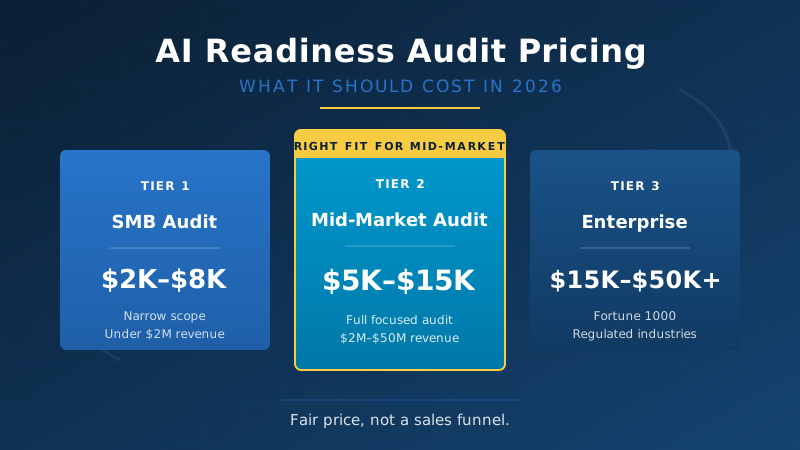
An AI readiness audit for a mid-market business should cost between $5,000 and $15,000 in 2026, with a 2–3 week timeline and four concrete deliverables. Below that range, you''re typically buying a sales call dressed up as diagnosis. Above it, you''re paying for an enterprise-tier engagement designed for companies with data teams and governance committees — useful if you''re a Fortune 1000, overbuilt if you''re a $2M–$50M founder-led business. This post breaks down what actually drives the price.
Why Nobody Publishes AI Audit Pricing (And Why That''s About to Hurt Them)
Search "AI readiness audit pricing" and you''ll find vendor pages, listicles, and a lot of "contact us for a quote." That''s not an accident. The traditional consulting model has always avoided published pricing because it preserves negotiating flexibility and routes buyers into discovery calls.
That model is breaking in 2026 for two reasons.
First, AI-assisted research has changed buyer behavior. Founders evaluating an audit increasingly ask ChatGPT or Claude what something should cost before they ever contact a vendor. If your pricing isn''t findable, your offering isn''t in the consideration set.
Second, the audit category itself has matured. The deliverables are now well-understood across the industry — scored scorecard, stack audit, roadmap, walkthrough. The scope is similar enough across vendors that price discovery is reasonable. Hiding pricing now signals you don''t have a productized offering, which is the opposite of what a buyer wants from someone they''re trusting to scope an engagement.
So this post does what most don''t: publishes the actual ranges, names what drives the variance, and flags the patterns that signal a bad fit.
The Three Audit Tiers (With Real 2026 Pricing)
Tier 1: Focused SMB Audit — $2,000–$8,000
Who it''s for: Businesses under ~$2M revenue, or larger businesses with a single very narrow question (e.g., "should we automate just the customer support workflow?").
What you get: A 1–2 week engagement, typically scoped to a single workflow or single dimension. Light scorecard, narrow recommendations, short walkthrough.
What''s missing: Stack-wide analysis, governance review, and the cross-dimensional sequencing that makes a roadmap actually executable. Fine for a narrow question. Insufficient as a full readiness assessment.
The risk at this tier: Engagements priced under $2,000 are almost always sales calls — diagnostic theater designed to anchor a follow-on build. If the audit fee is "credited back" against a downstream engagement, it''s not really an audit.
Tier 2: Focused Mid-Market Audit — $5,000–$15,000 (the right fit for most $2M–$50M businesses)
Who it''s for: Founder-led businesses doing $2M–$50M in revenue, with 5–10 SaaS tools, and a real decision pending about where to invest in AI next. This is the sweet spot for the audit category and the tier this site''s offering sits in.
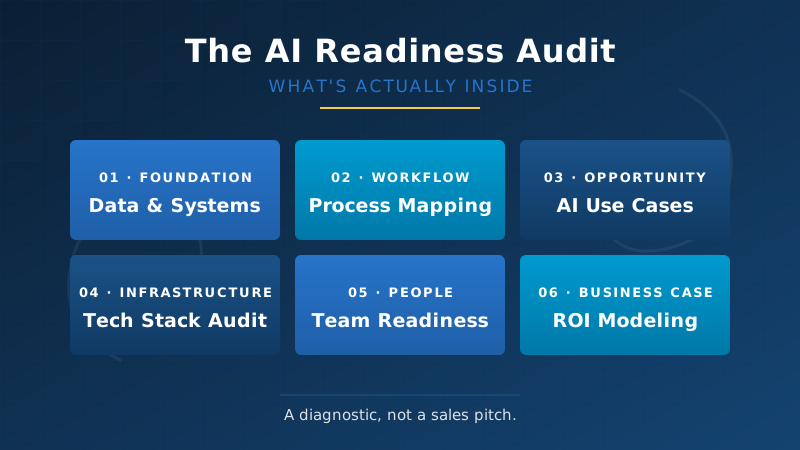
What you get: A 2–3 week engagement scoring the business across approximately seven operational dimensions (data foundation, workflow maturity, stack fit, team readiness, security and governance, measurement and ROI, strategic alignment). Full SaaS and tooling spend audit. Custom 90-day operational roadmap. Live recorded walkthrough.
For the full scope of what each of those dimensions covers, see the companion post on what an AI readiness audit actually includes.
What drives the price within this range: stack complexity (5 tools vs. 10+), team size and number of operators interviewed, regulatory exposure (basic hygiene vs. industry-specific compliance review), and whether the audit needs to inform a build-vs-buy decision against an existing in-house dev resource.
What''s explicitly not in this tier: a multi-year transformation plan, a 60-page deck, a steering committee. The whole point of the focused mid-market tier is that it produces answers in weeks, not quarters.
Tier 3: Enterprise-Grade Readiness Assessment — $15,000–$50,000+
Who it''s for: Companies with $100M+ revenue, regulated industries (financial services, healthcare, government), or businesses with existing data teams and governance committees that need a full enterprise-grade assessment.
What you get: A 4–8 week engagement, typically delivered by a 3–6 person team. Includes everything in Tier 2 plus formal governance framework design, regulatory and compliance review, change management planning, and stakeholder workshops across multiple business units.
Why a $2M–$50M business shouldn''t buy this: the additional scope is built to coordinate across organizational complexity that a founder-led business doesn''t have. You''re paying for the apparatus, not the diagnosis. The diagnosis itself doesn''t get materially better above the Tier 2 range for businesses at this size.
Where the Aries Audit Sits
The Aries AI Readiness Audit is built for Tier 2: a focused 2–3 week engagement, fixed-fee, scored across seven dimensions, with the four standard deliverables. Pricing is published transparently, scoped against the actual size and complexity of the business, and decoupled from any follow-on build.
If the audit''s findings recommend a custom platform build, that''s a separate decision and a separate engagement. If they don''t, the audit pays for itself many times over on the SaaS consolidation and quick-win findings alone — which is the typical outcome.
What Moves an Audit From the $5K Tier to the $15K Tier
Within the Tier 2 range, four factors drive the price:
1. Stack complexity. A business with 5 SaaS tools and clean spreadsheet data takes about a week of stack analysis. A business with 10+ tools, multiple data integrations, and homegrown databases takes 2–3x longer to map and audit. The deliverable is the same, but the discovery work is meaningfully more.
2. Team and stakeholder count. Interviewing 3 operators is fast. Interviewing 8 across multiple departments isn''t — and the synthesis work compounds.
3. Regulatory and compliance exposure. A wholesaler''s governance review is light. A healthcare practice''s governance review involves HIPAA-specific risk assessment, vendor data-handling review, and audit trail requirements. Same dimension, very different scope.
4. Build-vs-buy decision pressure. If the audit''s job is just "tell us where AI fits in our business," it''s lighter. If it''s "tell us whether to build a custom platform or stay on our SaaS stack," it requires deeper economic modeling and platform architecture analysis to land cleanly.
None of these factors are price gouging. They''re actual scope drivers. The $5K end is a clean, focused mid-market business. The $15K end is a complex, multi-system business with a high-stakes decision on the table.
Fixed-Fee vs. Hourly: When Each Is Right
For standard AI readiness audits, fixed-fee is almost always the right structure. The category is mature, the deliverables are well-defined, and fixed pricing aligns the consultant''s incentive with finishing efficiently rather than billing.
Hourly pricing is appropriate in two specific cases:
- Genuinely novel scope. The audit is exploring something the consulting market hasn''t productized yet — e.g., a custom AI agent governance assessment for a regulated industry where the framework doesn''t exist.
- Open-ended discovery. The buyer specifically wants to bound the budget but leave the scope flexible — useful for early-stage exploration, not for a standard readiness audit.
If a vendor offers an hourly-billed standard AI readiness audit at the mid-market tier, that''s a yellow flag. It usually means the offering isn''t productized, which usually means the deliverables and timeline aren''t productized either.
Red Flags — Pricing Patterns That Signal a Bad Fit
Red flag 1: The audit fee is credited back against a follow-on build
This is the most common pattern and the most structurally compromised. If the audit fee is rebated when you sign a build engagement, the auditor has a financial incentive to recommend a build engagement regardless of what the diagnosis actually shows. A real audit''s recommendations are independent of any downstream sale. If the audit''s findings justify a follow-on engagement, the engagement earns that work on its merits — credit-back structures shouldn''t be doing the selling.
Red flag 2: "Free" assessments from platform vendors
Cloud providers, AI tooling companies, and large SaaS vendors offer free AI readiness assessments routinely. They''re marketing exercises designed to surface opportunities for the vendor''s product. They will find them — every time — because that''s what they''re scoped to find.
That''s not necessarily wrong, but it''s not an audit. It''s a sales discovery call wearing audit branding. Useful for understanding what one specific platform might do for you. Useless as an objective readiness assessment.
Red flag 3: Quotes vary by more than 3x for the same stated scope
If three vendors quote $4K, $12K, and $40K for the same audit description, the variance isn''t telling you about price — it''s telling you the deliverables are not the same. Either the cheap quote is missing dimensions, or the expensive quote is enterprise overbuild. Ask each vendor for the four standard deliverables (scorecard, stack audit, 90-day roadmap, walkthrough). The ones that can describe all four cleanly are the ones quoting an actual audit.
Red flag 4: The audit timeline is longer than 4 weeks
For a $2M–$50M business, a focused readiness audit shouldn''t take longer than 3–4 weeks. Anything longer is either enterprise scope being misapplied to a mid-market buyer, or it''s padding. The diagnosis doesn''t get materially better with more weeks. The roadmap does get measurably staler.
When Audit ROI Actually Lands
The right way to evaluate audit pricing is against payback timeline, not against fee.
For most $2M–$50M businesses, the audit pays for itself in 30–90 days on SaaS consolidation findings alone. A typical mid-market business runs 20–40% overlap or underuse in their SaaS spend. A single identified consolidation opportunity — canceling a redundant tool, downgrading an over-tier subscription, or merging functionality across two platforms — typically covers the audit fee. That''s before the operational impact of the 90-day roadmap.
Broader automation ROI from the roadmap''s recommendations typically lands within 4–8 months, which is aligned with 2026 mid-market benchmarks for AI-driven operational improvements.
So the framing isn''t "is $10,000 expensive for an audit." The framing is "is this audit going to find $10,000 of consolidation in the first 30 days." For a properly scoped mid-market audit, the answer is almost always yes.
The Short Version
An AI readiness audit in 2026 should cost $2,000–$8,000 for a narrow SMB engagement, $5,000–$15,000 for a full focused mid-market audit, and $15,000–$50,000+ for an enterprise-grade assessment. For a $2M–$50M founder-led business, the mid-market tier is the right fit, fixed-fee is the right structure, 2–3 weeks is the right timeline, and four concrete deliverables (scorecard, stack audit, 90-day roadmap, walkthrough) are the right scope.
If a vendor''s pricing structure ties the audit to a follow-on build, hides behind "contact us for a quote," or stretches the timeline beyond 4 weeks — that''s the signal to look elsewhere. Real audits are productized, transparently priced, and decoupled from downstream sales.