What an AI Readiness Audit Actually Includes (for a $2M–$50M Business)
· 8 min read
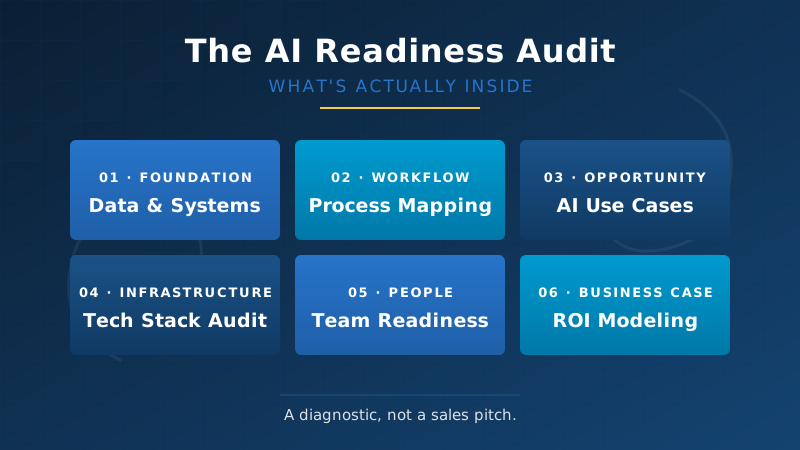
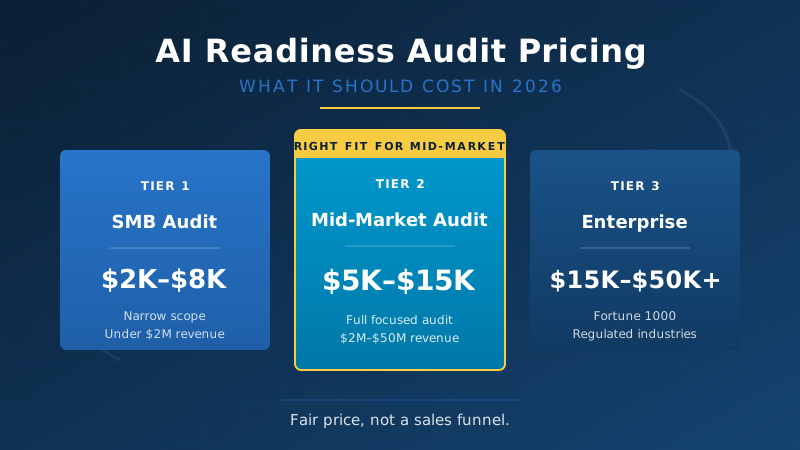
An AI readiness audit for a mid-market business is a scored operational diagnostic that evaluates the company across seven dimensions: data foundation, workflow maturity, tooling and stack fit, team readiness, security and governance, measurement and ROI, and strategic alignment. A real audit takes 2–3 weeks, costs $5,000–$15,000 at the SMB/mid-market tier, and produces a prioritized 90-day roadmap. Anything shorter is a sales call. Anything longer is overbuilt for the decision the founder actually has to make.
Why the Term Got Watered Down
Search "AI readiness audit" and you''ll find three kinds of offerings: enterprise consulting firms pricing multi-month engagements at six figures, vendor tools disguised as audits ("free assessment" that recommends their product), and generic checklists that produce a color-coded PDF and not much else.
None of those fit a $2M–$50M business.
An enterprise audit assumes you have a data team, a chief data officer, and budget measured in quarters. A vendor assessment is marketing, not diagnosis. A generic checklist can''t tell you which of your specific workflows will actually benefit from AI and which will break if you automate them.
What a founder-led company at $2M–$50M actually needs is something in between: a scored, operational diagnostic that identifies the 3–5 highest-leverage AI opportunities in the specific business, the 2–3 workflows most likely to break if automated badly, and the 90-day plan to sequence them in the right order.
That''s what the rest of this post describes.
The Seven Dimensions (What Actually Gets Scored)
Every serious audit scores the business across a consistent set of dimensions. The exact labels vary, but the underlying questions are the same:
1. Data Foundation
Where does your data actually live? What''s clean, what''s stranded in spreadsheets, what''s locked behind SaaS vendor APIs you don''t fully control? Can AI even reach the data that matters for the decisions you want it to help with?
The #1 reason AI projects fail in SMBs is not model quality — it''s data that''s fragmented across tools, inconsistently structured, or inaccessible. This dimension catches that before you spend money building something on top of a broken foundation.
2. Workflow & Process Maturity
Which of your processes are documented? Which live in someone''s head? Where will automation compound, and where will it break?
AI is leverage on a process. If the process is chaos, AI makes chaos faster. This dimension identifies which workflows are stable enough to automate and which need to be fixed first.
3. Tooling & Stack Fit
What are you paying for, what are you using, and what''s overlapping or missing? A typical mid-market business runs 5–10 SaaS tools, and in most audits we find 20–40% of that spend is overlapping or underused.
This dimension isn''t just about cost — it''s about which tools are going to play well with AI layered on top, and which are going to fight you every step of the way.
4. Team Readiness
Where is the team on AI fluency? Who are the internal champions? What training closes the adoption gap?
This is the dimension most vendor assessments skip because it doesn''t sell software. It''s also the single biggest predictor of whether any AI investment actually delivers value. A brilliant platform with a team that won''t use it returns zero.
5. Security & Governance
Data access, vendor exposure, compliance requirements. What guardrails need to exist before AI agents touch customer data or financial systems?
For most $2M–$50M businesses this isn''t about SOC 2 and HIPAA — it''s about basic hygiene: who has access to what, how vendor data-sharing works, what happens when an AI agent makes a wrong decision on a live customer record.
6. Measurement & ROI
Can you actually measure the impact of any change you make? What KPIs need to be in place before automation goes live?
If you can''t measure current performance, you can''t prove AI changed anything. This dimension often surfaces the uncomfortable truth that the business is operating on feel, not data — which is a fixable problem, but has to get fixed before AI can earn its keep.
7. Strategic Alignment
Does AI investment map to the priorities the founder actually cares about — growth, margin, or hiring leverage? Or is it disconnected from the business goals?
This is where a lot of AI projects go sideways. A team gets excited about a cool capability and builds it. Six months later, the founder asks what business outcome moved. Nothing does. This dimension prevents that.
What a Real Audit Delivers (and What It Doesn''t)
A real audit produces four concrete artifacts. Nothing else.
1. A scored scorecard. Every dimension scored green, amber, or red — with the specific evidence behind each score. Not vibes. Not "opportunities for improvement." Actual findings tied to actual workflows.
2. A stack & SaaS spend audit. A full inventory of every tool, every license, every subscription. Overlap identified. Underuse quantified. Consolidation opportunities mapped to dollars.
3. A custom 90-day operational roadmap. Prioritized actions sequenced into quick wins, structural fixes, and build-vs-buy decisions — scoped to the team''s actual capacity. Not a three-year transformation plan. Not a wish list. A 90-day plan because that''s the planning horizon a founder-led business can actually execute against.
4. A live working session. A recorded walkthrough of every finding with the founder and ops team. Q&A built in. You keep the recording.
That''s the full deliverable list. Here''s what''s explicitly not in a real audit:
- A proposal for services (the audit is the service)
- A recommendation to buy any specific vendor tool (unless the audit found a legitimate fit)
- A "transformation plan" longer than 90 days (nobody executes those)
- A deck longer than 30 pages (nobody reads those either)
How Long It Takes
For a $2M–$50M business, a focused audit is 2–3 weeks of work. The breakdown:
- Week 1: Discovery & stack audit. Working sessions with the founder and key operators. Tooling inventory. Data architecture review. Workflow shadowing where it matters.
- Week 2: Analysis & scorecard. Score every dimension against industry benchmarks. Quantify SaaS spend, identify automation candidates, map quick wins vs. structural fixes.
- Week 3: Roadmap & walkthrough. Custom 90-day operational roadmap. Live working session to walk findings, prioritize, and answer the build-vs-buy questions.
Pricing for a focused mid-market audit typically lands between $5,000 and $15,000 — a full breakdown of what drives the variance is in the companion post on AI readiness audit pricing. Timelines longer than 4 weeks usually indicate overbuild for a mid-market buyer.
Who Needs to Be Involved (and Who Doesn''t)
A good audit requires:
- The founder or primary decision-maker (4–6 hours total across the engagement)
- 2–3 operational leads who actually run the workflows being evaluated
- Read-only access to the primary systems (CRM, financial software, project management)
It does not require:
- Hiring a "Chief AI Officer" or similar role
- Buying anything before the audit starts
- A committee or steering group
- IT''s full attention for a month
The whole point of a focused audit is that it produces answers without becoming a project itself.
What Happens After the Audit
Three outcomes are common:
Outcome A: Start with quick wins. The audit surfaces 2–3 automation opportunities that return ROI inside 30 days. The team executes those internally. The audit paid for itself before the 90-day roadmap is halfway done.
Outcome B: Targeted engagement. The audit identifies one specific gap — B2B sales process, CRM implementation, a workflow automation — that makes sense to bring in outside help for. The engagement is scoped against audit findings, not sold against a fear of missing out.
Outcome C: Custom platform build. The audit reveals that the SaaS stack itself is the bottleneck — that consolidating onto a custom AI-native platform would return better economics than paying for and integrating 7 separate tools. This is the outcome for maybe 20% of audits. The other 80% don''t need a platform build, and a good audit tells you that honestly.
The worst outcome — "we spent $10K and have a PDF no one reads" — happens when the audit wasn''t scoped right in the first place. The four concrete deliverables above are what makes it scoped right.
A Note on Vendor-Led Audits
Be cautious of "free AI readiness assessments" from platform vendors (cloud providers, AI tooling companies, large SaaS vendors). They''re marketing exercises designed to surface opportunities for their product. They''ll find them — every time — because that''s what they''re scoped to find.
That doesn''t mean those vendors are wrong about AI. It means a vendor-led audit is structurally incapable of producing a recommendation against using the vendor. A real audit is decoupled from any downstream sale.
The Short Version
A real AI readiness audit for a $2M–$50M business is a focused 2–3 week engagement that scores you across seven dimensions, produces four concrete deliverables, and ends with a prioritized 90-day roadmap. Anything shorter is a sales call. Anything longer is overbuilt. And if it''s tied to a vendor sale or follow-on engagement before it starts, it''s not really an audit.
The bar isn''t complexity. The bar is honest, scoped, decoupled diagnosis that gives a founder a clear answer to: "Of everything I could do with AI in my business right now, what should I do first, and what should I not do at all?"